
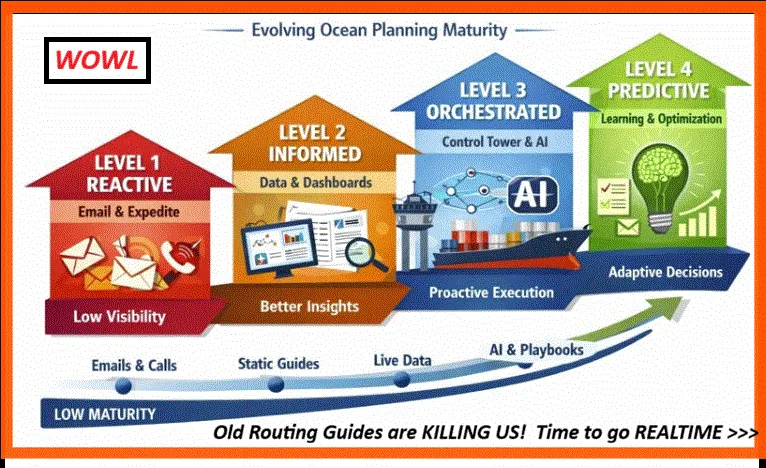

Right now, ocean planning is too static for the world we ship in. Capacity shifts, sailings move, and real transit times drift away from what the plan assumed. When conditions change, it’s hard to update routing guides and allocations fast—so we fall back on emails, calls, and last-minute expediting. That’s low maturity (0–1): we can spot problems, but we can’t steer outcomes consistently.
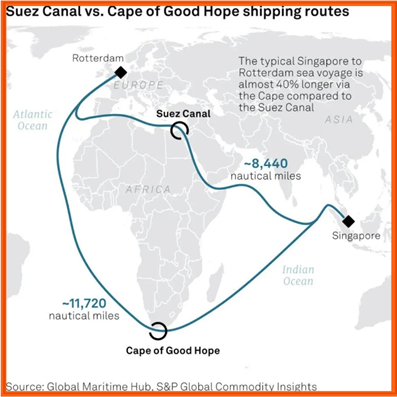
The Suez situation is a perfect example of why this matters. For years, Red Sea risk pushed many Asia–Europe, Med, and East Coast Americas services around the Cape of Good Hope. Now, some carriers are cautiously moving parts of the network back toward Suez. That can cut voyage time by roughly 10–14 days. If we don’t adjust quickly, we’ll plan the wrong lead times, carry the wrong buffers, and choose the wrong strings—either wasting money “protecting” freight that doesn’t need it, or getting surprised by shortages and missed dates.
Ocean also has a hard rule: optimize before you book. Book about three weeks before sailing and get carrier confirmation at least two weeks prior. After booking, protect execution—don’t re-shop for a cheaper or slightly faster vessel.
So, the real question becomes: how do we choose the right service up front, using the most current schedules and realistic transit expectations?
That’s how leaders move to Level 3 (orchestration) and toward Level 4 (learning):
· Build lane “service profiles” by trade lane + carrier string (Far East→USWC/USEC/N. Europe; Intra-Asia; Indian Subcontinents/N. Europe). Treat transit time as a range, not a single number.
· Link to carriers, NVOs, and forwarders so schedules and transit expectations refresh continuously—especially during big shifts like Suez vs. Cape routing. (and YES AI is core)
· Use AI to flag “late-likely” risk early and prioritize critical inventory in transit by PO/SKU/need-by date.
· Run a simple cadence:
o Pre-book (T–28 to T–21) choose the right string/allocation (updated constantly!)
o Post-book (T–21 to sail) confirm, document, execute with playbooks, then do quick post-mortems. (check that technology, that data and continually upgrade the processes)
o Review performances all around
WOWL provides the control tower team, the carrier/NVO data links, and the AI-powered discipline to keep plans current and execution steady—so customers reach full performance: fewer surprises, better reliability, and lower total cost.
AndyG@WOWL.io WOWO.io
#Logistics #OceanFreight #GlobalTrade #ControlTower #SupplyChainAI #TMS #FreightForwarding #NVOCC #ITMS

