
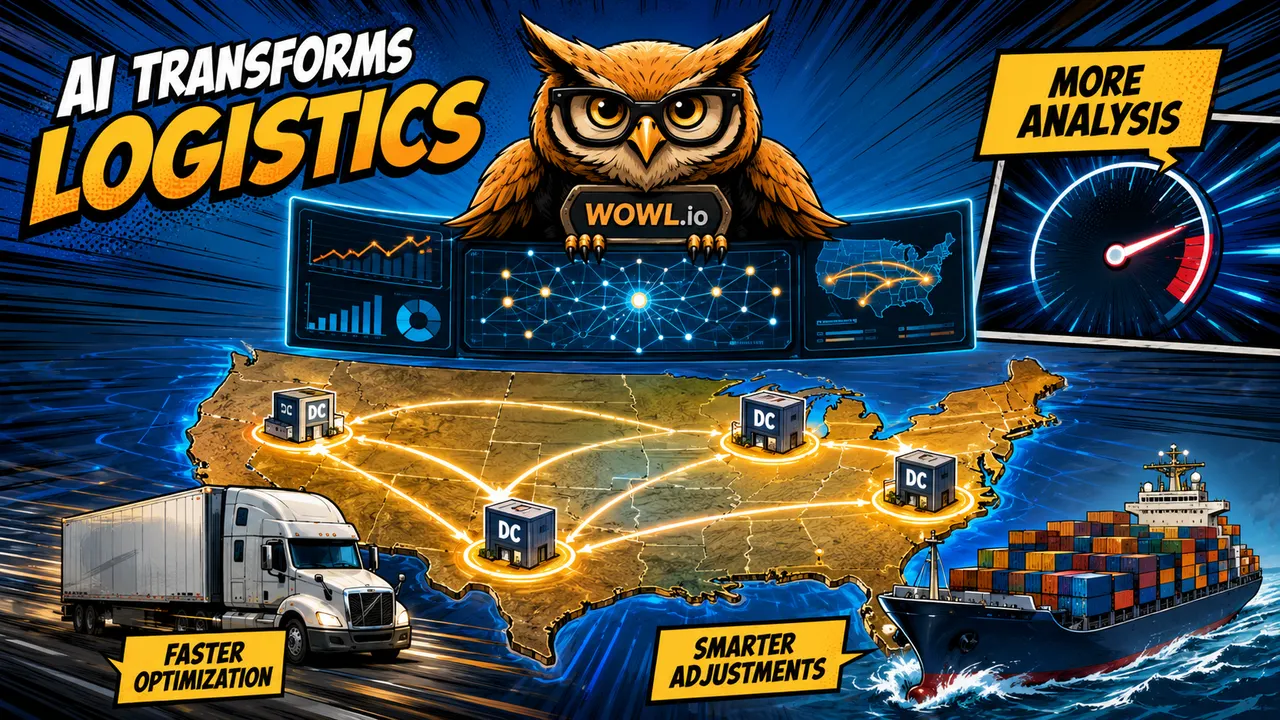

Many people talk about AI as if it will reduce work.
In logistics, the opposite will happen.
AI will make analysis faster, deeper, and more useful. And because of that, companies will want more of it — not less.
Take as one example Distribution Network Optimization projects.
For years, these projects have been major undertakings costing $100k or more with consultants. A company would study their distribution network and where the DCs are current compared to where they ought to be. How many DCs they have versus how many they should have. And then which customers each DC should serve, how inventory should be positioned, and how product should flow from factories, suppliers, ports, and import gateways to the final customer. It’s a massive effort to do well but its has a huge payoff in service improvements, inventory reductions and overall costs.
That means digging through shipment history, demand data, product detail, supplier locations, freight rates, warehouse costs, carrier service, and inventory assumptions. Then comes the hard work: building scenarios, testing trade-offs, and deciding what network makes the most sense for cost, service, reliability, and growth.
Because these studies are so complex and expensive, many companies only do a full network review every five to ten years.
But markets do not wait five to ten years to change.
Customers move. Demand shifts. Freight rates change. Ports get congested. Carrier performance changes. Labor costs move. Inventory strategies evolve. A network that looked right three years ago may still be structurally sound, but the way it operates may need real adjustment.
This one of the examples of how AI changes the game.
AI will not just help companies complete a network study faster. It will make it practical to review, refresh, and improve the network far more often.
A company may not move warehouses every quarter. But it can adjust which DC serves which customers. It can shift inventory. It can test whether parcel, LTL, and truckload shipments should follow different regional rules. It can review whether offshore product should flow through a different port. It can compare service, cost, and risk before small problems become expensive ones. And if one of the AI benefits is that data quality and access will continue to improve, then more optimizations studies will be requested or even required.
That creates more work, not less.
· More analysis.
· More scenario planning.
· More optimization.
· More adjustment.
· More experienced logistics professionals who know the right questions.
AI can process more data faster than we ever could manually. But it still needs human judgment. The lowest-cost answer is not always the best answer. A model may look clean on paper and still fail in the real world.
Can the carrier handle the volume? Did you just renegotiate your contracts? Or even just a couple of them? Tweak your network to take advantage of the fast turn around of online optimization capabilities!
Will service suffer? Is the warehouse labor market reliable? What happens during disruption? You can run new models in your optimization tools because the data is ready and AI is already your partner.
AI will give logistics teams more leverage. But it raises expectations and will improve outcomes faster and more often.
The future of logistics will not be less analysis.
It will be better analysis, done much more often.
And the best logistics professionals are going to be busier than ever.
AndyG@WOWL.io Check out our newsletters at WOWL.io
#AILogistics #ITMS #NetworkOptimization

