
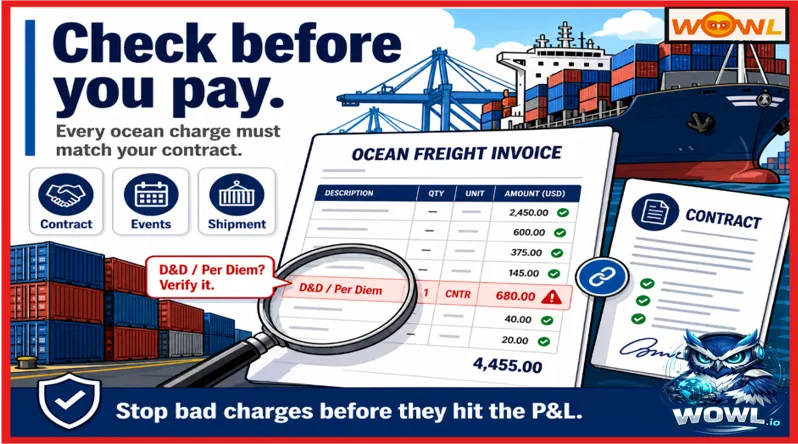
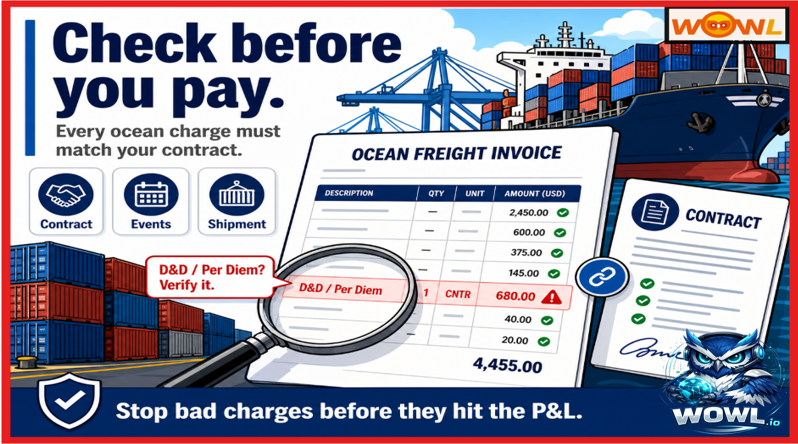

What is your best practice for paying ocean freight bills? The rule is simple: don’t approve an ocean invoice unless each charge ties back to your contract terms and the shipment events.
Why do errors happen? Because ocean billing is complex. Rates change. Start dates and end dates get mis-read, misunderstood. Surcharges move. Contract language is complex. Billing data may come from multiple systems. Manual inputs still creep in. And D&D and per diem charges are especially vulnerable because they also depend on dates, free-time rules, pickup and return events, and actual equipment movement. If even only one timestamp or rule is off, the invoice can be wrong. General freight audit guidance shows errors often come from misaligned data, manual mistakes, and inconsistent rate application.
In ocean container shipping, invoice control starts with one basic truth: if you do not have the contract or at least a strong Sales Level Agreement (SLA) and good shipment data in a usable form, you cannot properly audit the freight bills.
Ocean invoices are not just ocean freight. They include bunker, PSS, chassis, terminal fees, handling, documentation, destination charges, and the charges that create the most pain: detention, demurrage, and other per diems. These are often accepted as “normal” cost, when in fact they are frequently wrong, unsupported, or billed outside agreed terms. Freight audit sources say invoice reviews should match charges back to shipment data, contracted rates, and agreed conditions before payment is released.
Worse yet the per diem charges many times are invoiced separately long after your original freight bill has been processed and paid.
If your contracts are setup up correctly from your procurement process, you will have an easier time building links to contracts and e-invoices that many of your carriers and forwarders now provide.
The cost impact is real. Many programs find that basic invoice auditing typically finds 1% to 3% of freight spend recoverable, and stronger programs can find much more recovery. My own experience is that a solid pre-pay audit to find 3% to 7% average adjustment savings.
Post-audit recoveries tend to run between 2% to 5% on your paid freight bills. And you must add another full task to perform those post-audits.
For ocean shippers, the lesson is simple: don’t wait until after you’ve paid a freight bill to correct errors or challenge per diem charges. The best approach is to review invoices before payment—validating charges against contract terms, event data, and shipment details—so incorrect costs never reach the P&L.
Get it right the first time!
AndyG@WOWL.io
Newsletter for you? sign up for nothing at WOWL.io
#logistics #oceanfreight #freightbills #auditfreight #ITMS #originmgmt

