

Opening snapshot
June is a tight, carrier-managed market. Demand is not at a pandemic-level, but it is firm enough to support increasing rates and then peak-season rate surcharges. Usable capacity is being absorbed by Suez/Cape diversions, Hormuz risk, port congestion at many key container ports, blank sailings, further slower steaming, and bunker fuel costs.
Bottom line: protect your critical freight. Book earlier, confirm space and equipment before cargo release, and do not wait for the lowest spot quote before your booking and sailing needs. Protect reliability, good transit times. Be aware of more surcharge risk.
1. June executive read
|
Market signal |
June read |
WOWL move |
|
Demand |
Early peak season is here.
Asia export bookings are firm and some cargo is moving early. |
Tighten forecasts and book
critical ocean 3-4 weeks ahead. Peak season should end early
(by end of August or early September) |
|
Capacity |
Nominal fleet growth is not translating into easy space. Detours,
congestion, slow steaming, and blanks cut usable capacity. |
Confirm sailing, space, equipment, cutoffs, and weight rules
before cargo release. |
|
Rates |
Spot, FAK, PSS, EBS/BAF,
and inland fuel costs are moving up together. |
Update budgets, shorten
quote validity, and separate base rates from surcharges. Build in more “fee” protections in your
next contracting. |
|
Reliability |
Rolled cargo, vessel bunching, and transshipment delays are the
real operating risk. |
Add buffers on time-sensitive freight and monitor sailing
integrity weekly. |
|
Main risk |
Middle East security and
fuel remain the swing factors. |
Build freight plans with
ranges, not one fixed rate assumption like 80/20 split on MQC vs spot
flexibility.. |
2. Rate movement – fast read
How to read it: the percentages compare current spot levels to prior benchmarks. Positive means today is above that benchmark; negative means today is below it. The near-term view is a WOWL market call, not a formula.
|
Lane / lane group |
YoY |
6 mo. |
1 mo. |
Fast read |
|
China / East Asia to USWC |
-36% |
+80% |
+22% |
Still below last year, but
the fastest rebound in the table. Do not wait. |
|
China / East Asia to USEC |
-29% |
+67% |
+20% |
Higher routing risk and stronger absolute cost pressure. |
|
Southeast Asia to North
America |
-39% to -31% |
+62% to +72% |
+18% |
Vietnam and SEA booking
windows are extended; protect space early. |
|
East Asia / China / SE Asia to North Europe |
+37% |
+42% |
+37% |
Already above last year, but reliability may be more important
than the rate. |
|
East Asia / China / SE Asia
to Med / North Africa |
+14% |
+41% |
+42% |
Med/MENA lanes carry a
rerouting and premium-space risk. |
|
South India / Sri Lanka to Med / North Africa |
+52% |
+50% |
+23% |
Hottest relative lane in the table. |
|
Transatlantic Europe to
USEC |
+8% |
+45% |
-4% |
Softer near term; price
lane-by-lane, not market-wide. |
|
Australia import lanes |
+8% to +59% |
-11% to -3% |
+5% to +15% |
Mixed. China / East Asia to Australia is the clearest pressure
point. |
|
Rate-table callout: Transpacific is still below last
year but tightening fast; Europe/Med is already above last year;
Transatlantic and Australia are not following the same curve. The business
risk is rate momentum plus space protection. |
||||
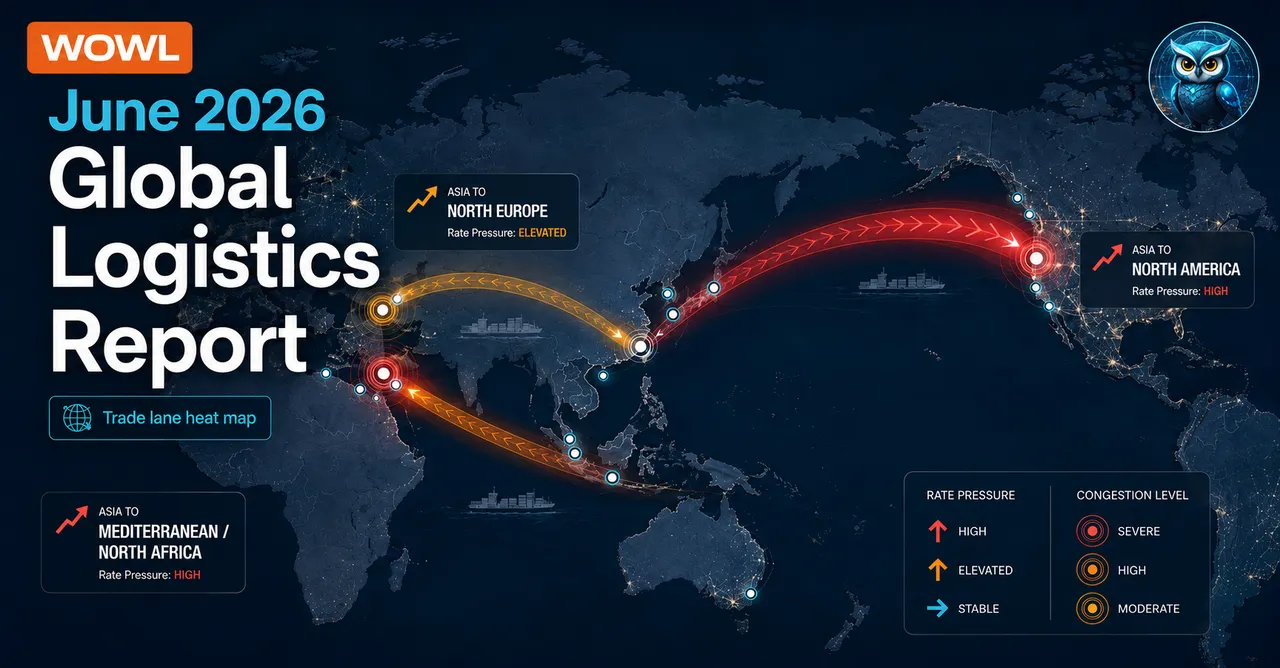
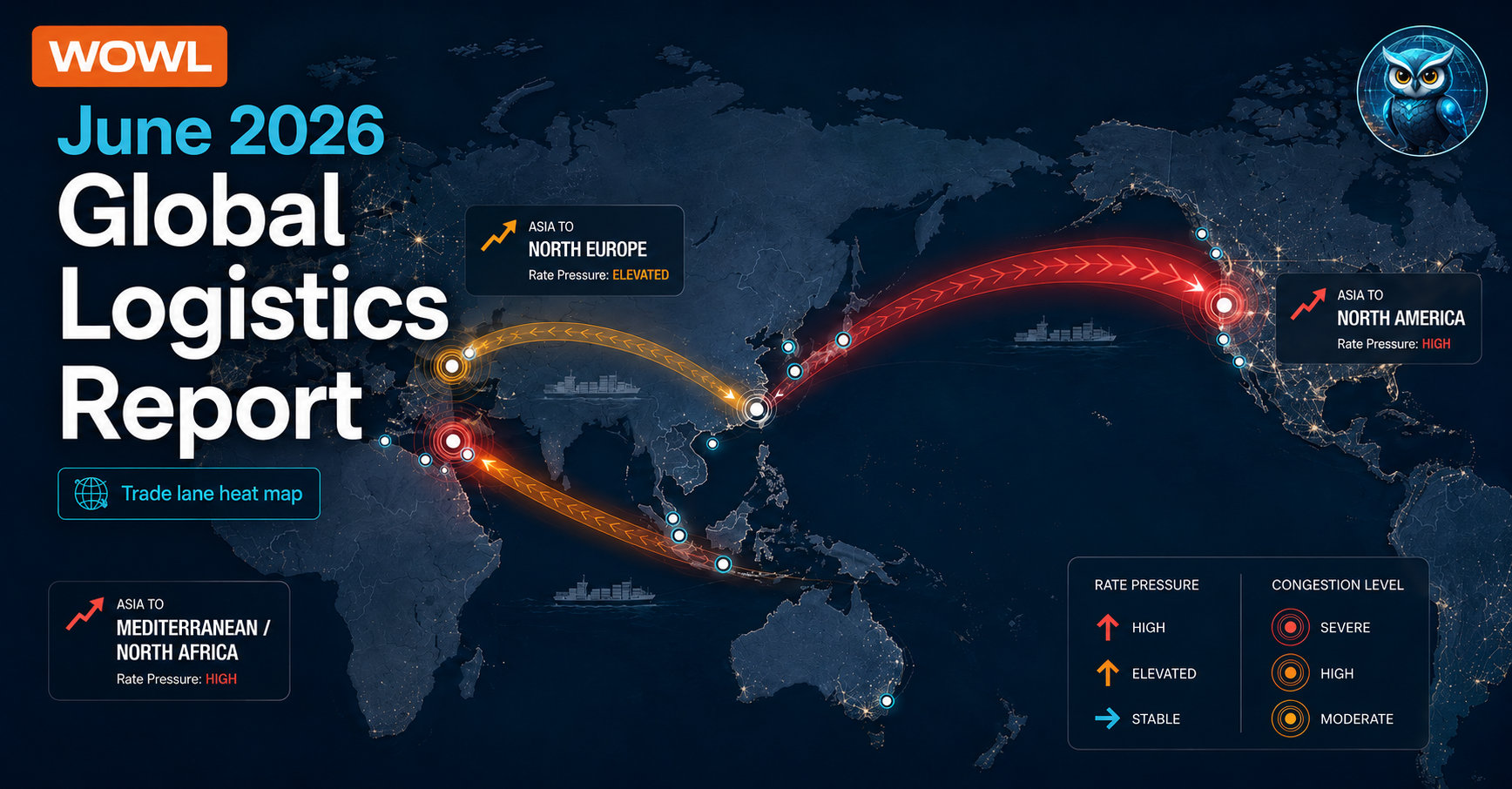
3. Trade-lane heat map - next 6 to 8 weeks
|
Lane |
Demand |
Space / reliability |
Rate trend |
Action |
|
Asia to NA West Coast |
Firm |
Tight, with selective extra
loaders |
Up |
Book 3-4 weeks early for
critical cargo. |
|
Asia to NA East & Gulf |
Firm to strong |
Most constrained; China/Vietnam tight |
Up sharply |
Protect space; review VGM/heavy cargo early. |
|
Asia to North Europe |
Firm |
Tight from Cape routing, port,
and inland congestion |
Up |
Add buffers and confirm
space before release. |
|
Asia to Med / North Africa |
Strong |
Tight with Suez/Gulf rerouting premium |
Up sharply |
Use premium options only where service need justifies it. |
|
ISC / Sri Lanka to NA &
Europe |
Steady to rising |
Constrained; hub
reliability uneven |
Up |
Lock space early and plan
around transshipment risk. |
|
Intra-Asia / Transatlantic |
Strong / stable |
Feeder pressure on Intra-Asia; workable but less flexible
Transatlantic |
Up / mixed |
Price lane-by-lane; watch hubs, schedules, and equipment. |
4. Structural watch
|
Watch item |
What it is doing now |
WOWL guidance |
|
Suez / Cape routing |
Longer voyages continue to
absorb effective capacity and hurt schedule recovery. |
Keep longer lead times in
the plan. A sudden Suez return could pressure rates lower, but do not budget
on that headline alone. |
|
Hormuz / Middle East risk |
Security risk keeps fuel, insurance, and routing risk active. |
Review surcharges weekly and keep alternate routing options
ready. |
|
Bunker and inland fuel |
Ocean and inland fuel
pressure are now part of total landed cost, not a side note. |
Separate base freight,
fuel, PSS, dray, and rail assumptions in customer pricing. |
|
Port congestion |
Asia, ISC, Middle East, North Europe, and selected North America
gateways remain uneven. |
Confirm cutoffs, terminal conditions, equipment, and inland
capacity before committing delivery dates. |
5. Port & gateway watchlist
Repeating that many key, strategic ports globally are impacted by congestion of vessels and high utilization of their terminals. This is slowing down the vessel turn around greatly. This is one of the bigger impacts on our reliability and ocean capacity currently.
|
Region |
Hotspots |
What to watch |
|
Far East & SE Asia |
Qingdao, Shanghai, Manila,
Tanjung Pelepas, Singapore, Busan |
Vessel bunching, feeder
pressure, weather, cutoffs, and transshipment delay. |
|
ISC & Middle East |
Mundra, Nhava Sheva, Karachi, Colombo, Jeddah, Sohar, Khor Fakkan |
Hub buffers, export prioritization, Gulf risk, and equipment
availability. |
|
North Europe |
Antwerp, Hamburg,
Bremerhaven, Rotterdam, Southampton |
High yard utilization, rail
disruption, crane work, and slow inland handoff. |
|
North America |
LA/LB, NY/NJ, Savannah,
Vancouver & Prince Rupert, select rail ramps |
Bunched vessel arrivals, rail dwell, dray appointments, and
chassis availability. |
6. Air freight - quick view
|
Area |
June read |
Use it this way |
|
Demand |
Positive globally, with
Asia-linked flows and some ocean-to-air conversions. |
Reserve air for urgent,
high-margin, or service-sensitive freight. |
|
Capacity |
North China, South China, Taiwan, Vietnam, and Thailand show
short-lead risk. |
Book 5-7 days early; longer where flights are already full. |
|
Rates |
Fuel and capacity pressure
keep selected corridors expensive. |
Use an approval trigger:
revenue or customer promise must justify the premium. |
7. June shipper playbook
|
Priority |
Action |
|
Protect critical freight |
Book 3-4 weeks ahead. Use
named-space or premium options only where the order matters. |
|
Control landed cost |
Refresh rate cards, surcharge assumptions, and customer validity
windows now. |
|
Consolidate smarter |
Avoid half-full containers,
rushed LCL, partial pallets, and last-minute add-ons where planning can
prevent them. |
|
Segment the market |
Treat Transpacific, Asia to Europe/Med, ISC, Transatlantic,
Intra-Asia, and Australia as different markets. |
|
Escalate early |
Flag customer-promise cargo
before cutoff problems become service failures. |
Conclusion
June is not a panic market, but it is no longer casual. The winners over the next 6 to 8 weeks will plan earlier, protect the right space, consolidate better, and price the full cost of reliability. Consider using your contract negotiations period to focus more on the accessorials rate levels and rules.
WOWL helps clients manage global ocean and air freight with market guidance, carrier strategy, routing options, and hands-on execution. We connect market noise to shipment decisions. We have the expertise and the system tech/data that you need.
#OceanFreight #AirFreight #GlobalLogistics #SupplyChain #Transpacific #AsiaEurope #FreightMarket #WOWL
Andy Gillespie | AndyG@WOWL.io | Visit WOWL.io for more information and demo at https://www.wowl.io/demo-request/
Source scan used: uploaded WOWL June notes, 5-Jun-2026 rate movement workbook, WOWL monthly template, and the prior June public-source scan including Drewry, Xeneta, DHL, Kuehne+Nagel, Green Worldwide, Journal of Commerce public headlines, C.H. Robinson, IATA, and Bunker Index. Source scan completed June 4, 2026.

