

Opening snapshot
October opens with a divided market.
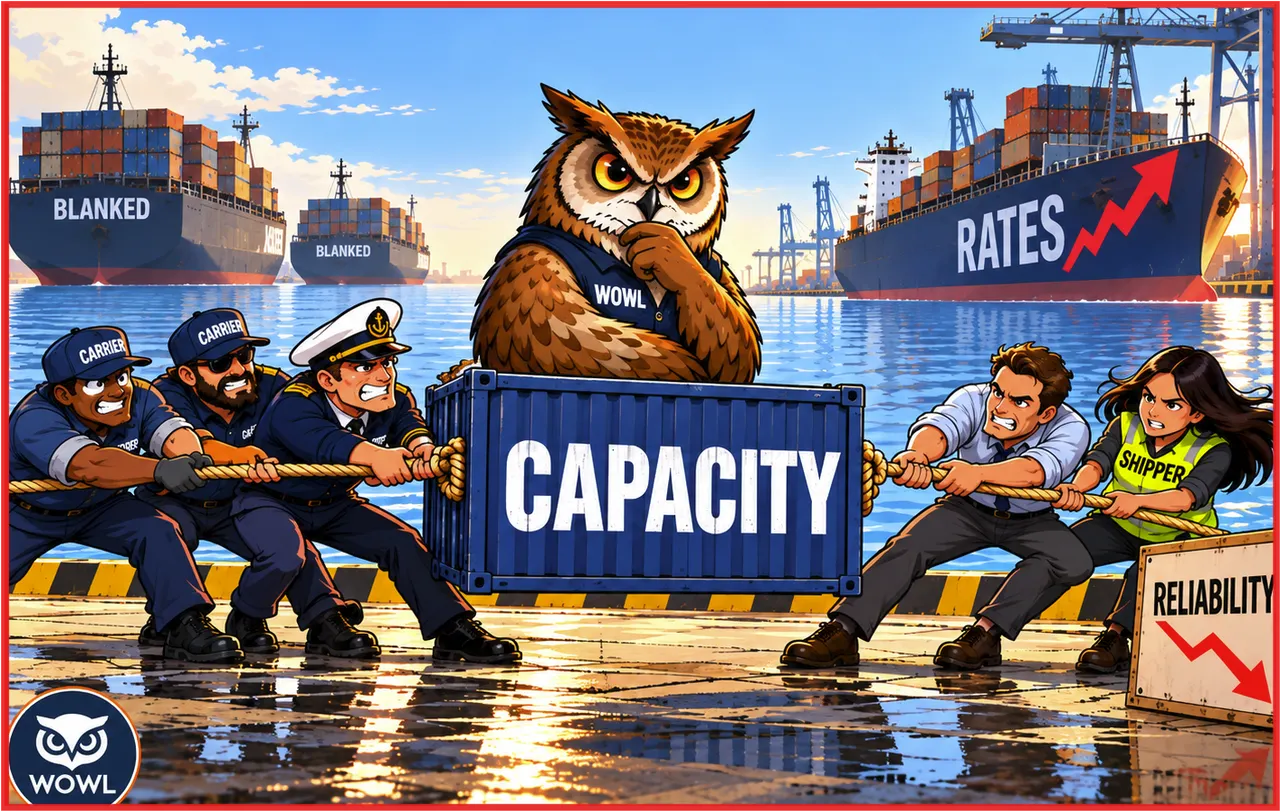
Transpacific Eastbound hot and heavy volumes, increasing prices and carrier blank sailings. Asia Europe softening demand, prices sliding lower and less cancellations, but ports are still congested.
The rate table shows Transpacific Eastbound freight still rising in spite of the normal Golden Week slowdown. Asia to Europe and the Transatlantic demand are easing. China/Vietnam space remains constrained through mid-month by high volumes and prior typhoons.
For the Transpacific market rising prices are a continuing concern but also reliability of transits and space. The global markets are almost all stressed with poor and worsening reliability of transits. The ocean carriers continue their retreat from improving services.
Action: Protect your critical inventory and price each lane separately. Inventory remains your key buffer on the lack of sailing and transit reliability.
Spot rate movement
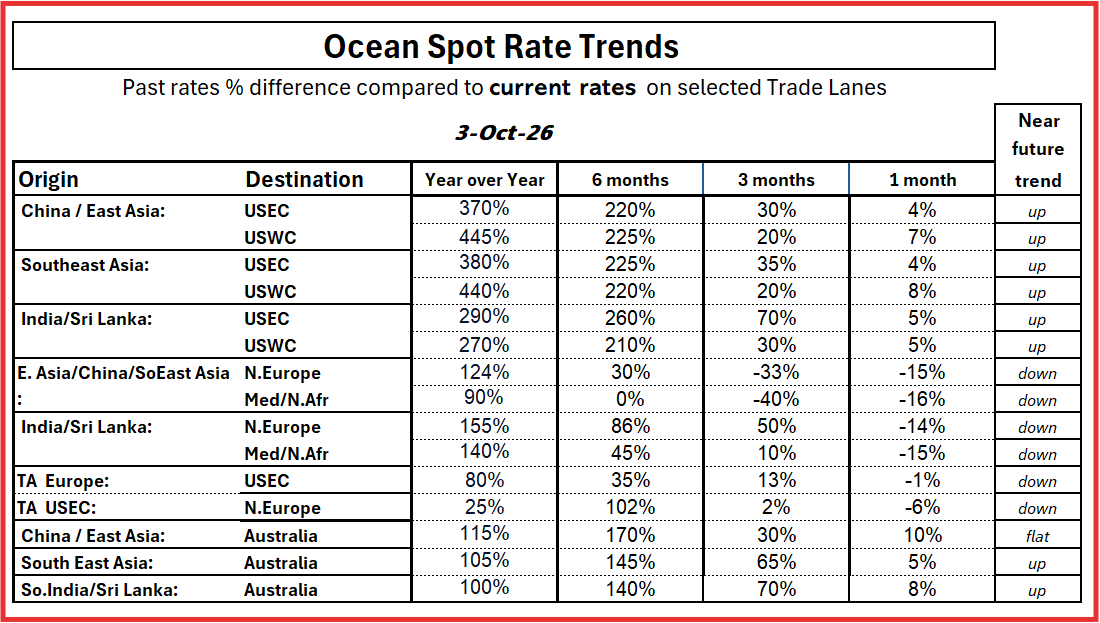
NOTE: We do not provide rates or average rates in the table. We show directional changes by percentage. Positive means current higher than the comparison period; negative means lower. Trend is our next 1–2-month opinion on rates/pricing direction.
WOWL trend read
US-bound lanes: +4–8% over one month. SE Asia–USWC leads at +8%; all six US-bound rows show an upward near-term view.
Q4 2026: Rates for Transpacific Eastbound to North America to soften after October.
Q1 2027: Further softening of rates especially after Lunar New Year as capacity aligns better with demand and carriers have more difficulty using Blank Sailing strategies.
Europe/Med from Asia down 15–16% over one month; ISC down 14–15%. ISC remains 10–50% above three months ago, showing a recent reversal.
Q4 2026 and Q1 2027 further softening of rates and good capacity expected. Europe port congestion especially from imbalance of super large vessels conflicting arrivals continue to impact Europe ports. Any continuing mix of Asia sailings through Suez and around Cape of Good Hope will continue to bury Europe container ports upon arrivals.
Transatlantic: westbound −1%, eastbound −6% over one month; both trend down. Australia: +5–10%; China’s forward view is flat, SE Asia and southern ISC up.
India–USEC: workbook +5% and trending up but space availability seems to be improving, and rates should moderate through rest of 2026.
Capacity and reliability
· Blanks: up to 60 possible cancellations out of 700+ sailings, for October. Transpacific accounts for the majority of global cancellations, Asia–Europe/Med >30%, and Transatlantic >10%.
· Bunching: scheduled Asia–North Europe Golden Week capacity is more than 25% above last year. Delayed ships inflate supply; do not be surprised by second half of October blank sailings increases.
· Reliability: August global vessel reliability again is below 50%; late vessels are late by an average of 7 days. Asia was even worse. Reliability continues to be a concerning area especially as the metrics used tend to favor carrier operations.
WOWL Priority Port Delays
China’s export backlogs and Colombo’s missed connections lead our watch. Europe’s terminal congestion and US rail dwell also threaten delivery dates. Ranked by WOWL’s assessment of shipper impact, blending public reporting.
|
Priority
and port |
Approximate
days and measure |
Cause
and impact |
|
1 Shanghai |
3.5–5 day average
vessel wait |
Volumes,
crowded yards & weather backlog. |
|
2 Colombo |
2–3 day vessel
wait; connections add time |
Gulf
diversions, crowded yards, and weather threaten feeder connections. |
|
3 Ningbo–Zhoushan |
2.5–3 day vessel
wait; more at affected terminals |
Crowded yards,
dredging, and weather recovery. |
|
4 Singapore |
1.5–2 vessel
wait; about 3 broader port delay |
Holiday cargo
and rolled shipments pressure onward connections. |
|
5 Shenzhen Yantian |
3–4 berth wait
for large vessels |
Crowded yards
and gate restrictions constrain exports. |
|
6 Rotterdam |
1–2
feeder/barge delay; about 3 broader port delay |
Yard
congestion and terminal interruptions complicate handoffs. |
|
7 Antwerp |
1–1.5 vessel
wait; about 4 broader port delay |
Excess empties
and crane-track repairs constrain handling. |
|
8 Los Angeles |
About 8 rail
dwell |
Import flows
pressure rail cargo after discharge. |
|
9 Hamburg |
2–2.5 vessel
wait; about 4 broader port delay |
Wind, crane
faults and construction; labor risk unresolved. |
|
10 Jebel Ali |
Service
disruption; reported vessel wait about 2.5 |
Conflict
restricts service access; waits may be unrepresentative. |
Also: Vancouver about 2 days vessel wait and 5 rail dwell; Savannah about 5 import dwell; Nhava Sheva about 2 vessel wait.
Act now: confirm final cargo availability. Align drayage, rail, and warehouse appointments. Protect critical inventory.
Canals and structural risk
Panama: 33 daily slots open from 15 October onward, up from 32; 49-foot Neopanamax draft restored now. Reservoirs and lake water levels remain critical.
Suez returns are selective and reversible with on again/off again situations with Houti attacks threatened. For Straits of Hormuz, disruption keeps direct vessels and & feeder alternatives disruption continues. Global fuel exposure continues.
Air freight quick view
Air is uneven. China–Europe weekly rates fell by almost 20%; China–North America was broadly steady. Technology cargo pulling a lot of the volume. Impacting air freight capacity are the growing restrictions near conflict areas
Outlook and shipper playbook
WOWL Q4 view: China/Vietnam usable space stays tight into late-October. Shanghai/Ningbo USWC bookings are effectively full through mid-October, Haiphong also. Europe demand softer and service should improve with increasing Suez capacity, if it hold. ISC remains service-specific; Australia depends on holiday demand and blanks.
Q1 2027 rates continue to ease especially after the pre-CNY push as capacity recovers.
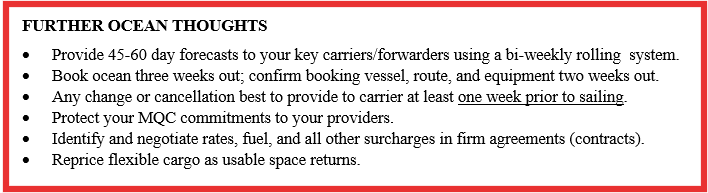
WOWL combines carrier-neutral systems, live operators, and analytics to manage exceptions.
Andy Gillespie | AndyG@WOWL.io | WOWL.io
#OceanFreight #GlobalLogistics #SupplyChain #FreightMarket #WOWL

