

WOWL.io market assessment
Shippers should have more room to negotiate on selected lanes, but a lower rate will not solve a missed connection or a slow inland exit. In fact, we don’t expect rates to drop back down to where they were a year ago, or even six months ago. That ship has likely sailed for a while to come.
However, Transpacific pricing should ease lower than current levels while Asia–Europe has in fact regained ground over the past month. Carrier attempts to lift prices still need to hold on bookings and they will use all the tools at their disposal to protect their pricing.
The November priority is clear: secure a workable route and delivery plan, then negotiate the full cost, not just the rate, to get your best value.
Spot rate comparison
The table compares current spot pricing with earlier periods. A positive percentage means today’s level is higher than the past period indicated. A zero, “0”, means the current rate level is about the same as the past period. Change is approximate % percentage change from past period to current. The latest rate workbook identified in the draft was dated 1-5 November validation as the rate comparison.
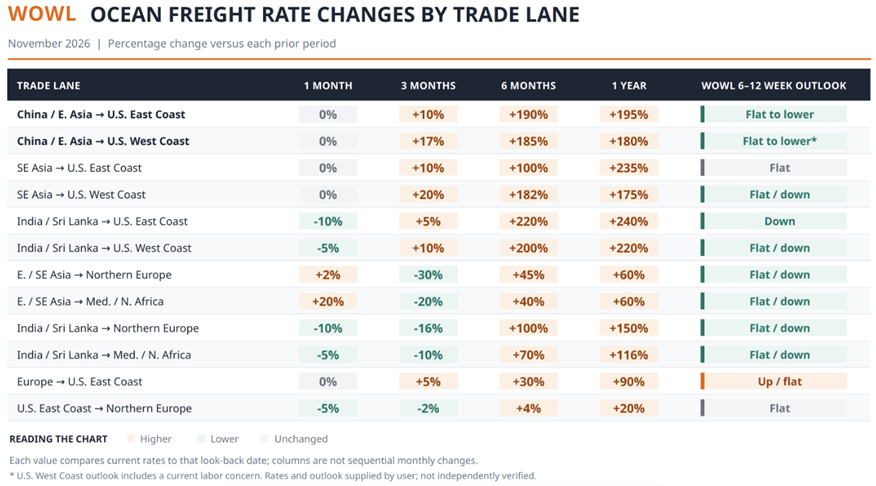
What's Happening Across the Major Trade Lanes?
Transpacific – Asia to North America
Rates are softening again finally, somewhat so far. Late October and early November reports show rates slipping 2-4% on major routes, particularly to the East Coast. West Coast rates are holding up a little better.
My view: Shippers have some room to push back and negotiate. But don't chase rates alone. Compare total costs, sailing schedules, transit times, and reliability. And remember, routing through the East Coast or Gulf only works if the inland delivery plan makes sense. Manage and negotiate total pricing, not just the rate.
Europe and Mediterranean
Carriers have managed to push rates higher recently, but I question how long that will hold. There is plenty of capacity in the market, and the possible return of more ships through the Suez Canal will create another round of disruption.
Some forecasts suggest North Europe arrivals could jump nearly 30% above normal during November. That could mean more congestion, longer port stays, and trouble getting containers inland.
Note that a shorter ocean transit doesn't help much if your container sits at the destination port waiting for days to get unloaded. Watch the total journey, not the schedule!
Indian Subcontinent
India to Europe rates remain soft, and space is generally available. That's good news for shippers looking to negotiate.
But available vessel space doesn't mean much if you can't get an empty container or make the feeder connection. Equipment shortages at some inland locations and around Ennore remain concerns. Cargo moving through Colombo also needs closer attention.
My advice: Push for better rates, but make sure the equipment, feeder connections, and mainline space are actually there before committing.
Australia and Other Trade Lanes
Carriers are again pushing for rate increases into Australia during November. Whether those increases will stick is another question. I would challenge them and look closely at actual market conditions before agreeing.
Transatlantic westbound rates also appear to be softening, while eastbound trends remain less clear.
Meanwhile, booking restrictions in the Philippines and inland transportation and refrigerated cargo issues around Santos, Brazil, deserve attention.
Bottom Line
I continue to see a market with plenty of ocean capacity but uneven demand. Carriers are working hard to protect rates, while shippers have opportunities to negotiate. Carriers may have the upper hand overall but you must fight hard for your piece of it all.
After more than 40 years in this business, one lesson keeps coming back: A cheap ocean rate doesn't mean a good transportation deal.
The real measure is getting your cargo from origin to destination, on time, with fewer surprises and at the best overall cost.
Negotiate hard. Check the details. And don't confuse available capacity with reliable service.
Capacity and Reliability – Still a Mess
Carriers continue to pull capacity to protect rates. For weeks 45–49, 56 of 715 scheduled sailings have been cancelled, nearly 8%. Almost half are on Asia–Europe routes, 36% on the transpacific, and the balance on transatlantic services.
Plenty of ships in the market, but not always where or when shippers need them. Don't trust the published schedule. Confirm the actual vessel and sailing.
Reliability? Still poor. September's global on-time vessel performance reached just 50.6%, with late ships averaging 6.65 days behind schedule. That's barely an improvement, and remember, these numbers measure vessels, not containers.
Shippers don't buy vessel arrivals. They buy cargo delivery. What matters is whether the container arrives when promised, clears the terminal, and reaches its final destination on time.
Meanwhile, the global orderbook exceeds 15 million TEU. More ships are coming, adding pressure on future rates, particularly from 2027 onward. But for the next few months, blank sailings, Suez routing, and port congestion will drive the real headaches.
My take: Capacity isn't the problem. Managing it is. Carriers are protecting rates while shippers continue paying for unreliable service. Negotiate hard, build realistic buffers, and hold your providers accountable for the entire journey.
Canals and structural risks
Canal routings can change both price and arrival patterns. An assessment dated 29 October places restored Suez container capacity at least half, but partial or one-way returns do not mean the network is back to normal. Faster voyages can release capacity while bunching arrivals at destination.
Panama’s 28 September notice provides for 33 daily slots from 15 October and a 49-foot Neo-panamax draft. Check the actual routing and reservation behind the quoted transit time.
Around Los Angeles and Long Beach, the planned Vincent Thomas Bridge closure from 7 November adds drayage uncertainty even while port facilities remain open. Confirm truck routing and pickup windows.
Major global container port status
These six ports are WOWL’s priorities for shipment review, rather than a statistically ranked global worst. Some have reported waits of roughly three days or more on particular flows; others face restrictions or inland dwell that can disrupt delivery. Views and actions below are WOWL assessments.
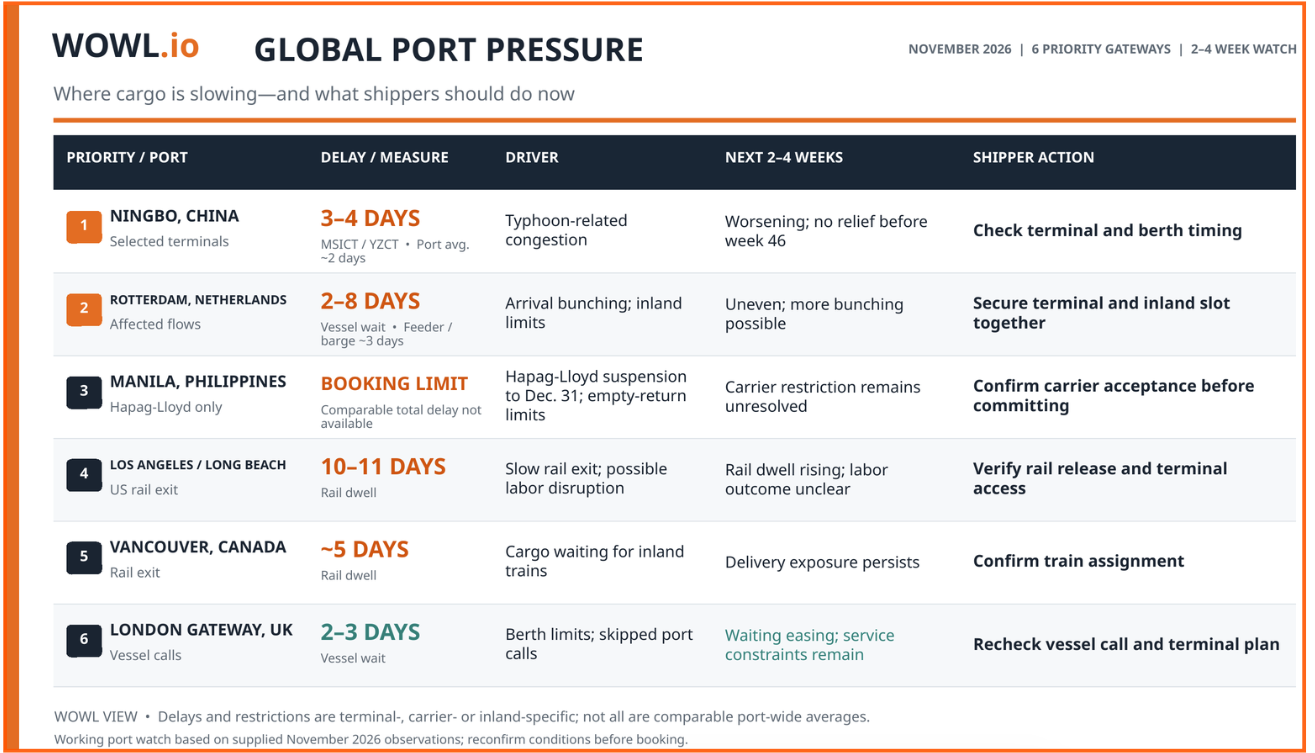
Count delay only where it occurs in the shipment’s actual sequence. Vessel waiting, connection time and rail dwell can overlap, so adding them can overstate the exposure
Air freight quick view
Emergency air recovery is becoming more expensive. The latest cited weekly update puts Far East–North America pricing 9% higher week on week and 40% higher year on year; Asia–Europe is 11% higher annually. Use air selectively for critical inventory and reserve recovery options before an ocean delay becomes urgent. Include the likely air cost when deciding whether a cheaper ocean service is worth the exposure.
WOWL Outlook – What Shippers Should Do
Through February, expect softer rates but plenty of bumps. Blank sailings, congestion and pre-Lunar New Year demand will keep markets unsettled. Suez reopening and more new ships could weaken carrier pricing power into 2027. But disruptions can change that quickly.
Watch European port congestion, weather delays, equipment shortages and inland bottlenecks. Don't use only one buffer for every shipment. Know your risks by lane and port.
Give carriers, booking agents and forwarders updated 45–60 day forecasts. Book three weeks ahead, confirm everything two weeks out. Negotiate free time, detention and surcharges along with rates.
My take: Push hard on pricing but never sacrifice service. Track the cargo, know your last free day and have a recovery plan ready. Cheap freight means nothing if the cargo doesn't deliver.
What is your take? Will the next 2-3 months, into the next quarter, be better for shipper pricing or worse? Will capacity be more available or less? Will carriers ramp up the use of blank sailings and other ways of reducing capacity?
Will the Lunar New Year impact the market in 2027 or fizzle out?
Andy Gillespie | WOWL.io
WOWL.io is a Global Ocean Booking Management provider, door to door! Check us out via a DEMO. Contact us at https://www.wowl.io/demo-request/
#BookingAgent #GlobalLogisticsBooking #GlobalOcean #OceanFreight #OriginManagement

